Studio operating model · Active use

Human-governed by design.

The Inverse Organization defines durable roles, authority boundaries, and shared project state so work can move across people, AI systems, and tools without losing continuity or accountability.

Today, one developer moves through every role with assistance from role-specific AI profiles. As the studio grows, collaborators can inhabit bounded parts of the same organization while contributing to one shared history, evidence base, and accepted project state.

Inverse Organization overview

Why it exists

Complexity should not erase continuity.

A growing project requires repeated movement between research, product direction, architecture, engineering, quality, creative work, operations, publishing, and risk. Today those functions are occupied by one developer working with AI assistance; the architecture keeps them explicit so future collaborators can enter without dissolving their boundaries.

The immediate task may still get done, but its reasoning, alternatives, unresolved questions, and return path can disappear as soon as attention moves elsewhere. The next session then spends energy reconstructing orientation or reinventing work that already happened.

The Inverse Organization gives each class of work a legitimate destination. Questions gain an owner. Decisions retain their lineage. Unfinished work keeps a recoverable point of re-entry. The human does not have to hold the entire studio in active memory for the studio to remain continuous.

The core idea

Three inversions define the studio.

The Inverse Organization is not simply a role map or an AI-assisted workflow. It was created by reversing three ordinary assumptions about how a studio forms, how AI enters it, and how product, infrastructure, and thought relate to one another.

First inversion

The restructuring came before the staff.

Most studios hire into growing complexity and formalize the organization later. Myriuna Worlds reorganized its single operator into 31 explicit roles before moving from prototype to production. Future collaborators can inhabit a structure whose authority, history, and handoffs already exist.

Occupants change; roles accumulate. Each person should leave the role more capable, explicit, and recoverable than they found it, so the next occupant begins further ahead rather than relearning the founder.

Second inversion

The studio is built for paired operation.

AI is not a tool added to a conventional studio. Myriuna's complexity made sustained human-AI operation a load-bearing requirement, so roles, records, Link and Sync, review, and context boundaries were designed for the pair from the outset. Capability is integrated; final authority remains human.

Third inversion

The pattern returns across scales.

Myriuna, the studio, CLE, and the movement between mythical and practical thought form a recursive system. Bounded local activity returns to a persistent whole, while evidence from implementation can travel back upward and reshape the originating vision.

The basic model

Work moves locally. Authority returns to the whole.

A bounded role receives the relevant context, advances a specific class of work, produces evidence or an artifact, and returns its findings to shared project state.

It does not receive the entire project indiscriminately. It receives a constructed local reality: the current accepted state, relevant history, purpose, authority boundary, evidence standard, stopping condition, and expected return artifact. A human contributor, role-specific AI profile, or combination of both can work inside that context without having to reconstruct the whole studio first.

Nothing produced locally becomes project truth automatically. Results are reviewed before acceptance, while contradictions, unresolved questions, rejected alternatives, and required handoffs remain part of the return. When the work crosses a role's authority boundary, it stops and routes onward rather than silently expanding its mandate.

Human intent
Role routing
Bounded work
Review and evidence
Accepted return

Claim boundary

A governed studio model, not a simulated workforce.

The terminology can sound larger than the mechanism. The practical boundary is simple: roles organize work and authority; they do not become independent people.

What it is

  • A human-governed organization.
  • Persistent specialist contexts.
  • Explicit authority and stopping conditions.
  • Evidence, status, lineage, and return paths.
  • Replaceable AI capability inside bounded work.

What it is not

  • Thirty-one autonomous employees.
  • A collection of separate identities.
  • AI sovereignty over project truth.
  • A biological or shared consciousness.
  • One enormous conversation pretending to be a studio.

Current operating structure

A durable studio shape for changing occupants.

The current model contains executive authority, specialist domains, individual role definitions, and one workflow connecting direction, production, independent review, release, and learning. The roles persist while human contributors, AI profiles, and tools can change.

Organization summary

2 executive roles
Studio Lead and Product Lead
8 operating domains
Research, Gameplay, Creative, Technical, Quality, DevOps, Marketing / Publishing / Communications, and Studio Operations / Compliance
29 specialist roles
Bounded roles distributed across those domains
1 unified workflow
Shared route from intent and classification through specialist work, review, acceptance, publication, feedback, and return

Process architecture

How raw material becomes accepted working truth.

The role architecture needs a route for material to move from strange first perception to bounded decision, implementation authority, review, operational memory, and human-controlled baseline. This overview settles the serious process before the longer capture article.

Overview · Discovery to Vault

The Inverse Organization Process

A front door for Discovery, Exploration, Compression, Review, operational memory, and the human-only Vault.

Optional side door

Inside the Inverse Organization

Two satirical side views of the same operating system: one maps the recurring functions; the other follows them through an ordinary working day.

Founder OS · Satirical operating map

The Founder’s Inner Organization

A satirical operating map of the recurring functions, tensions, and jurisdictions that surround one human sovereign.

Internal cultural document · Satirical working model

A Working Day at Myriuna

An ordinary workday inside the 31-role organization, including undocumented discoveries, adversarial validation, governance, and insufficient lunch.

Human-governed AI

Capability is distributed. Accountability is not.

The model separates contribution from authority. People, roles, AI systems, and tools may retrieve, generate, compare, challenge, and perform bounded work, but usefulness does not make their output authoritative. Human governance keeps responsibility located: accepted project state requires evidence, review, explicit risk acceptance, and identifiable human judgment. Capability can be distributed widely while accountability for what the organization treats as true remains human.

Contribution and boundary

Human
Supplies purpose, taste, judgment, responsibility, and risk acceptance. Cannot manufacture missing evidence.
Roles
Route questions, protect values, apply evidence standards, and define return paths. Cannot become autonomous persons.
AI systems
Retrieve, generate, compare, organize, challenge, and perform bounded execution. Cannot silently govern accepted state.
Records
Preserve continuity, lineage, status, contradiction, and reopening conditions. Cannot be reduced to a smooth retrospective story.

Continuity across interruption

The strongest test is recovery after absence.

A useful organization should not depend on one uninterrupted stretch of attention or one assistant remembering an entire project perfectly.

The system preserves why a decision was made, which alternatives were rejected, what evidence changed the direction, what remains provisional, and which role legitimately owns the next question.

That makes dormant work recoverable. A different AI model can enter a role. The human can return weeks later. A future collaborator can inherit part of the system. The project does not have to restart from the most recent conversation.

Periodic synthesis then returns accumulated change to human understanding. The records preserve broadly; the active role selects what matters; AI reasons locally; the human integrates globally.

A Jungian lens

Differentiation without fragmentation.

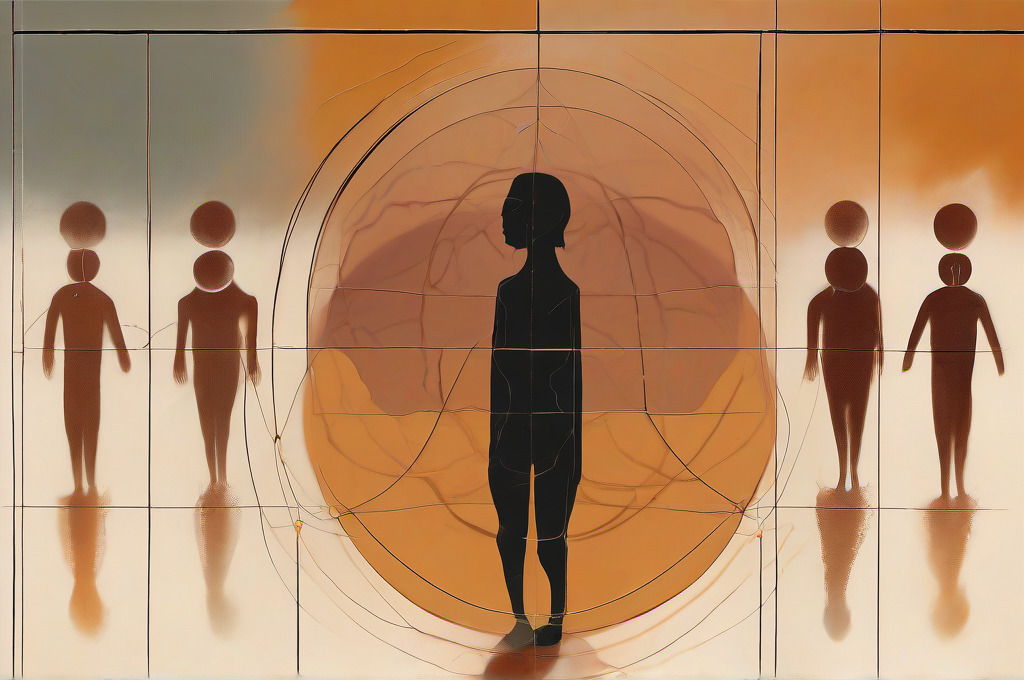
The Inverse Organization is a practical operating model first. It can also be understood through the Jungian idea of individuation: human capacities become differentiated enough to develop their own standards, challenge one another, and then return what they learn to a more coherent whole.

Research, architecture, engineering, quality, creative work, operations, and leadership are not separate personalities. They are functions already present within the work. The role system gives them names, boundaries, persistent contexts, characteristic strengths, and legitimate ways to oppose one another. Role-specific AI profiles can amplify those functions without becoming their owners.

In this interpretation, the project is not the only thing being developed. Repeated movement through bounded roles can train the operator to preserve uncertainty, tolerate contradiction, revise decisions, and integrate different forms of evidence without allowing one mode—technical, creative, visionary, cautious, or managerial—to become sovereign.

This is an additional lens on the architecture, not a claim that the roles are autonomous selves. The human remains the continuous developmental and authority-bearing subject.
The same principle at another scale

The studio architecture and the world architecture reflect one another.

Myriuna Worlds uses the Inverse Organization to govern development. Myriuna applies a related principle inside persistent worlds: local activity remains bounded while accepted consequences return to a larger state.

Studio scale

The human moves. Project context persists.

AI assistants work inside bounded role contexts without receiving authority to rewrite accepted project truth.

World scale

The player moves. The wider world persists.

AI-mediated actors and scenes express local reality without receiving permission to casually overwrite verified world state.

Open-loop principle

The model does not certify itself.

The Inverse Organization is judged by whether it produces coherent, recoverable, inspectable, and correctable work. Evidence, failed tests, collaborators, users, and public criticism must remain capable of changing the system.

The aim is not maximum AI output. It is governed progress that a human-led studio can understand, accept, and responsibly carry forward.